Additional Google albums are at the following links: group photos and session photos (images courtesy of Joe Shaw).
/
Additional Google albums are at the following links: group photos and session photos (images courtesy of Joe Shaw).
/
The 2019 Light and Color in Nature scientific conference was held on the campus of the College of the Atlantic (COA) in Bar Harbor, Maine on the United States’ east coast. Dates for this meeting were 15-18 July 2019 (Monday-Thursday). Obviously, registration and submission of paper proposals for review are now closed.

College of the Atlantic campus in Bar Harbor, Maine
Arrivals and registration started on Sunday afternoon (14 July 2019), with departures from campus housing required by Saturday morning (20 July). Housing for 36 persons was available on campus in dormitory rooms; Bar Harbor has a wide range of hotel and motel lodgings, but you must have booked these as early as possible (no later than May). The College’s large lecture hall (Gates Center), which has a digital sound system & projectors, was ours to use from 0800-2100 EDT on Monday-Wednesday.
During the week of 15-18 July, we had coffee breaks at the lecture hall, plus an off-campus lobster dinner on Thursday evening. The latter was available at modest extra cost, and vegetarian options were available. Campus housing, dining, and the lecture hall are all within a short walk of one another. COA also let attendees purchase individual meals. For friends and families of attendees, we organized numerous optional weekday activities during sessions.
An optional “excursion day” was on Thursday (18 July), and no sessions were scheduled that day. Adjacent Acadia National Park offers a wide range of hiking & biking trails and nature programs, both within the park itself and on nearby inland and coastal waters. Thursday’s travels included a schooner sailing trip on Frenchman Bay, followed by a bus tour of the park, complete with spectacular mountain views.
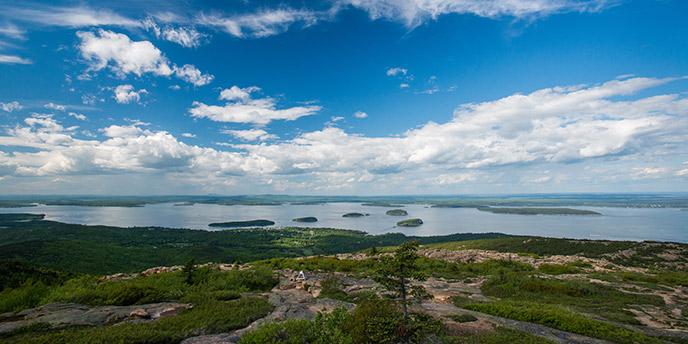
Frenchman Bay seen from Cadillac Mountain in Acadia National Park, Maine
2019 paper proposals were considered on:
• Rainbows & fogbows
• Halos
• Glories
• Atmospheric coronas
• Iridescence
• Sky color & polarization
• Visibility through the atmosphere, including airlight
• Mirages & atmospheric refraction
• Crepuscular rays & other atmospheric/terrestrial shadows
• Contrast phenomena
• De-weathering (i.e., airlight removal)
• Cloud optics
• Optics of lightning
• Brightness & color of the sun & moon
• Auroras, airglow, & zodiacal light
• Green, blue, & red flashes
• Optics of dust, soil, & rocks
• Color & light on & in water
• Iridescence & colors in biology & geology
• Atmospheric optics in history & archaeology
• Physics-based simulations of atmospheric & environmental optics
• Sensors & imaging techniques for natural optical phenomena
• Lab experiments related to atmospheric & environmental optics
Standard talks were allotted 20 minutes each, followed by a 5-minute question period. Joseph Shaw and Montana State University (MSU) kindly agreed to act as institutional sponsor for the conference.
Raymond Lee
U. S. Naval Academy
Here is a full-resolution group photo (6.9 MB) from the 2013 light and color meeting, held in Fairbanks, Alaska during 5-8 August 2013. Thanks to Ken Sassen for being our host and conference organizer! (Photo by Joseph A Shaw)
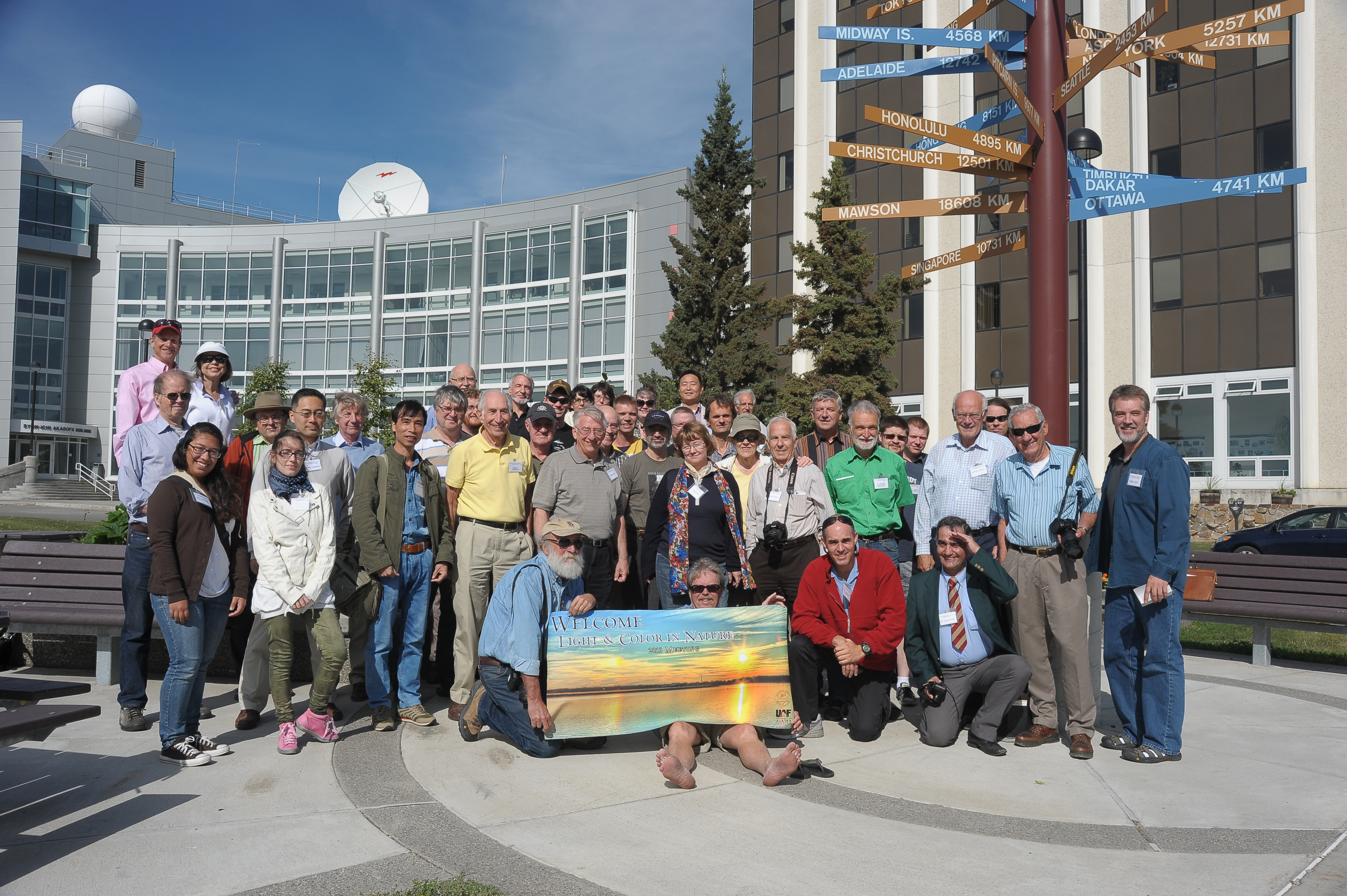
Group picture from 2013 light & color meeting – Fairbanks, AK (Joseph A Shaw)
The 2013 meeting in Fairbanks, Alaska was a huge success! Thank you to everyone who participated, attended, or sent good wishes. We had a beautiful display of noctilucent clouds late on the meeting, as is shown in this image (copyright Joseph A. Shaw).
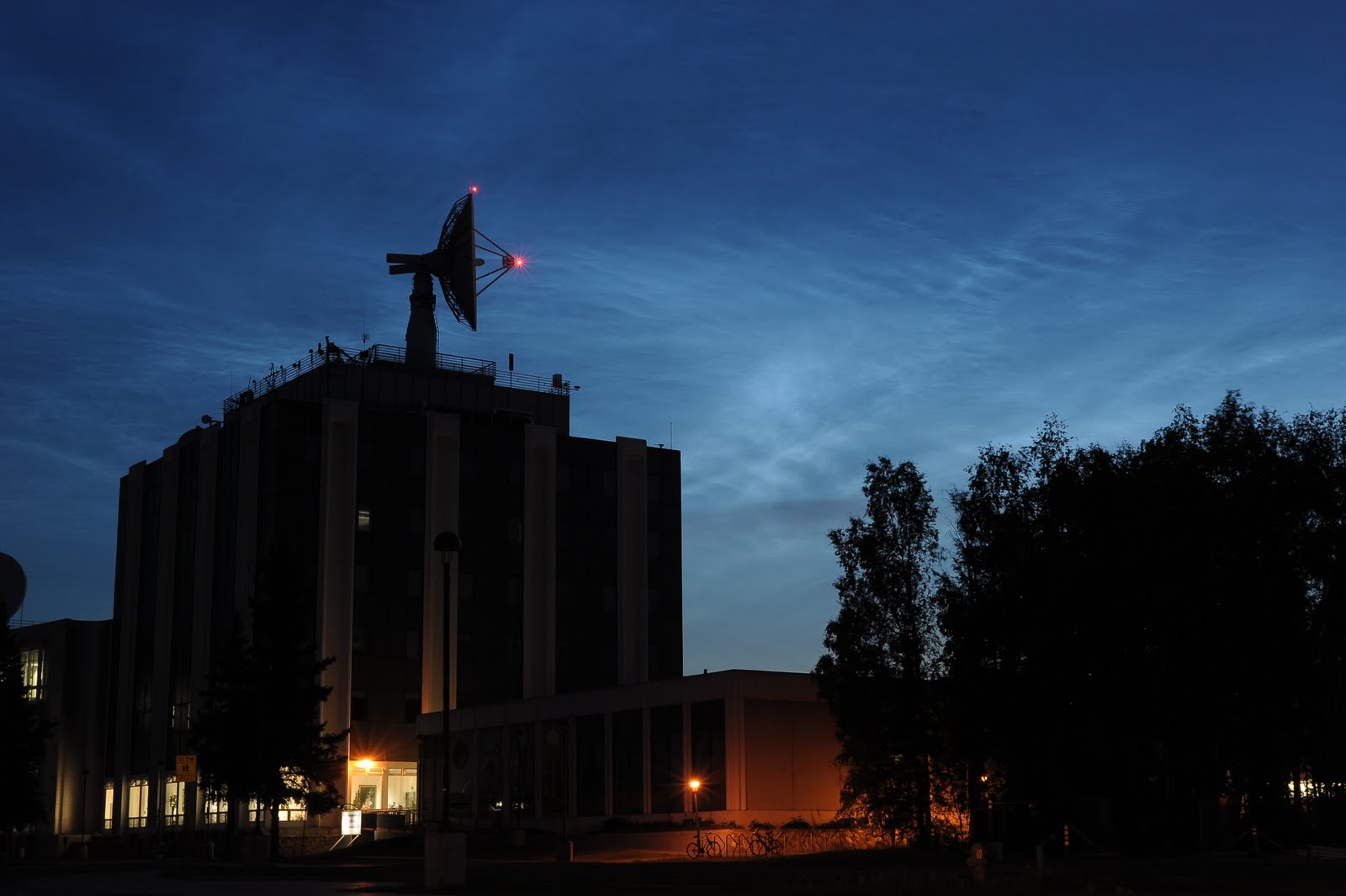
Noctilucent clouds and the Geophysical Institute (Joseph A. Shaw).
On the flight home, many people reported seeing great optical phenomena – including me (Joseph Shaw, Montana State University). I had superb displays of both noctilucent clouds and aurora as I flew through western Canada. Here are two samples …
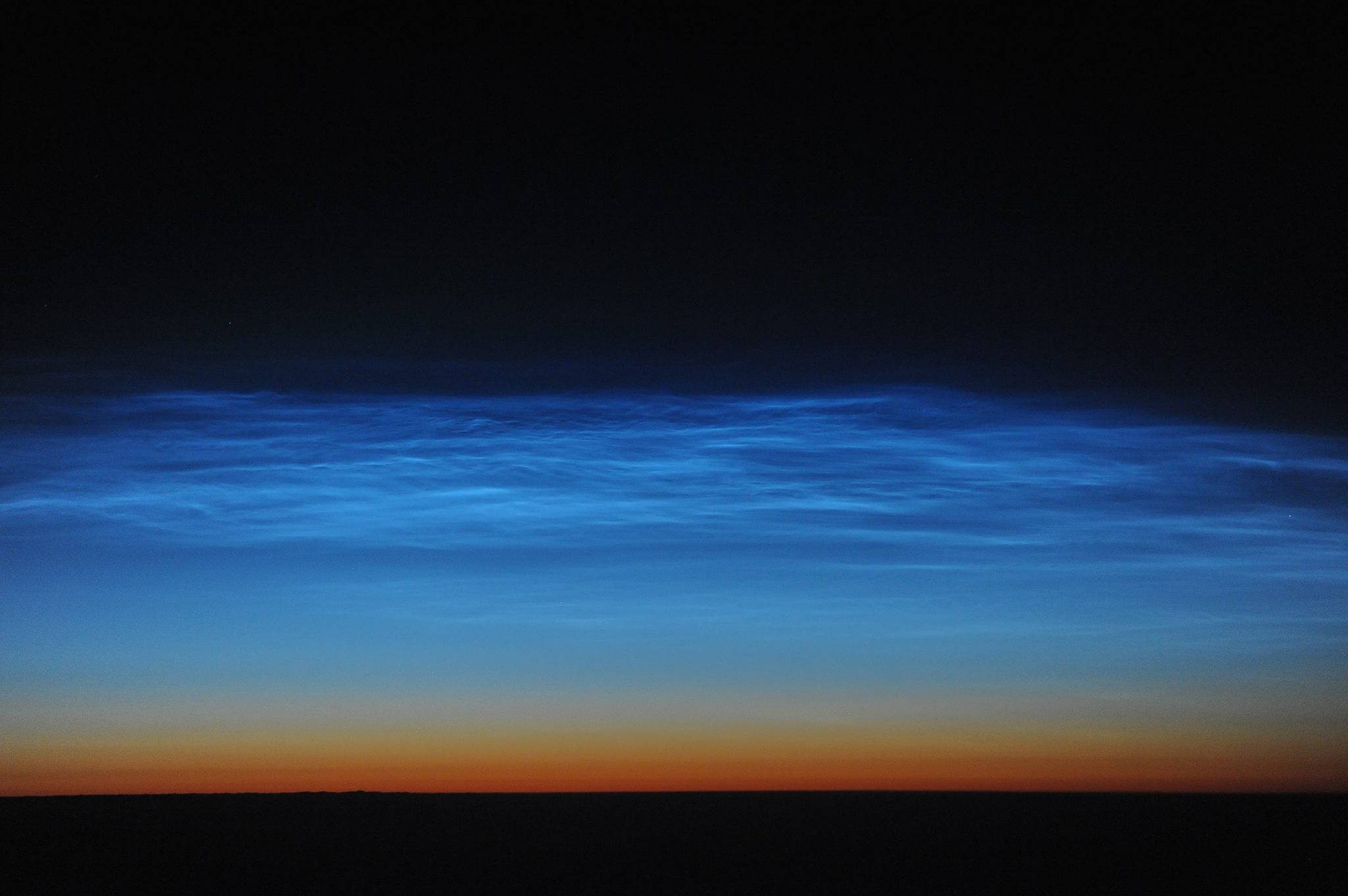
Noctilucent clouds seen from 11.8 km above western Canada (Joseph A Shaw)
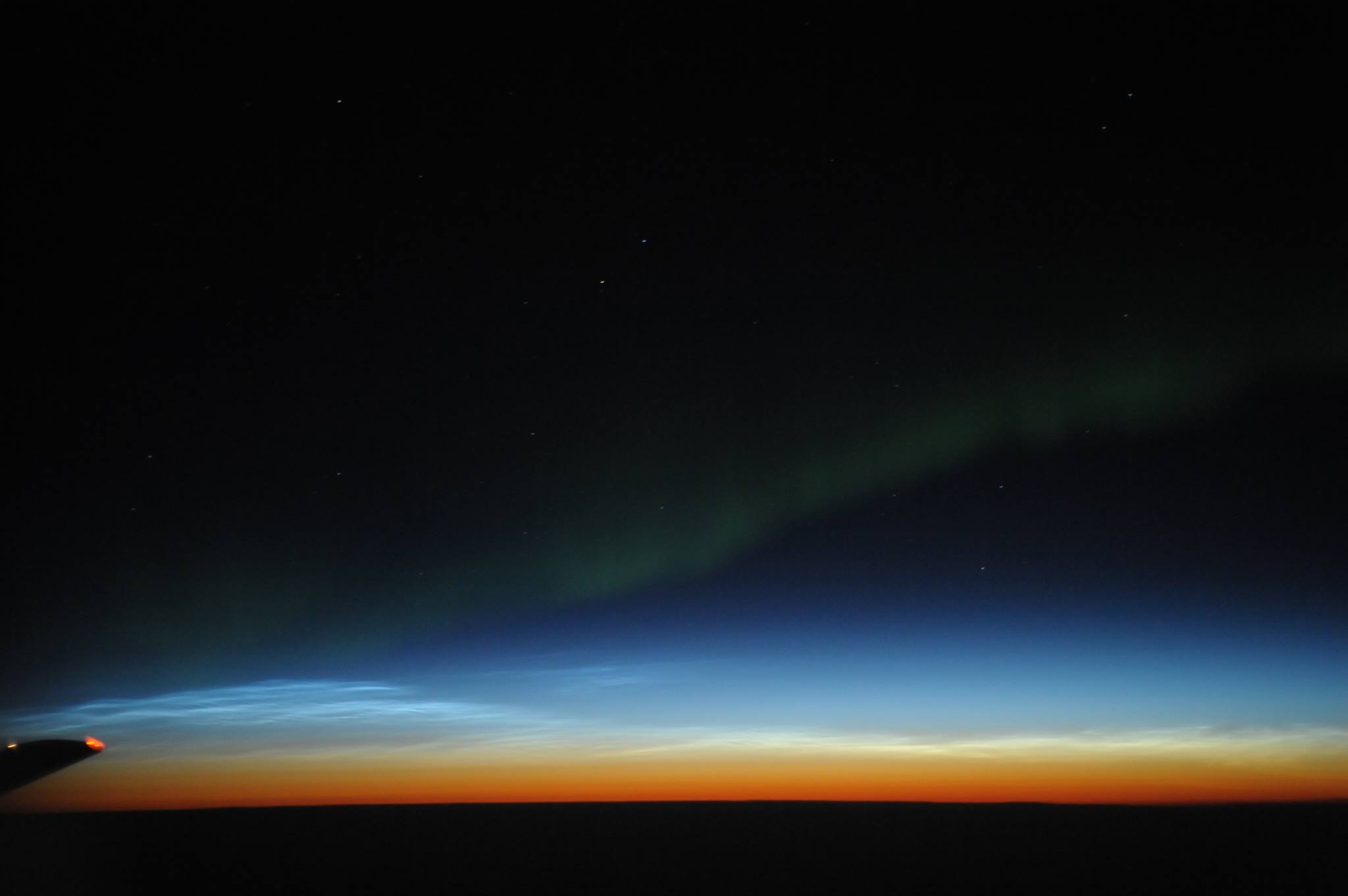
Noctilucent clouds and the Aurora Borealis over western Canada (Joseph A Shaw)
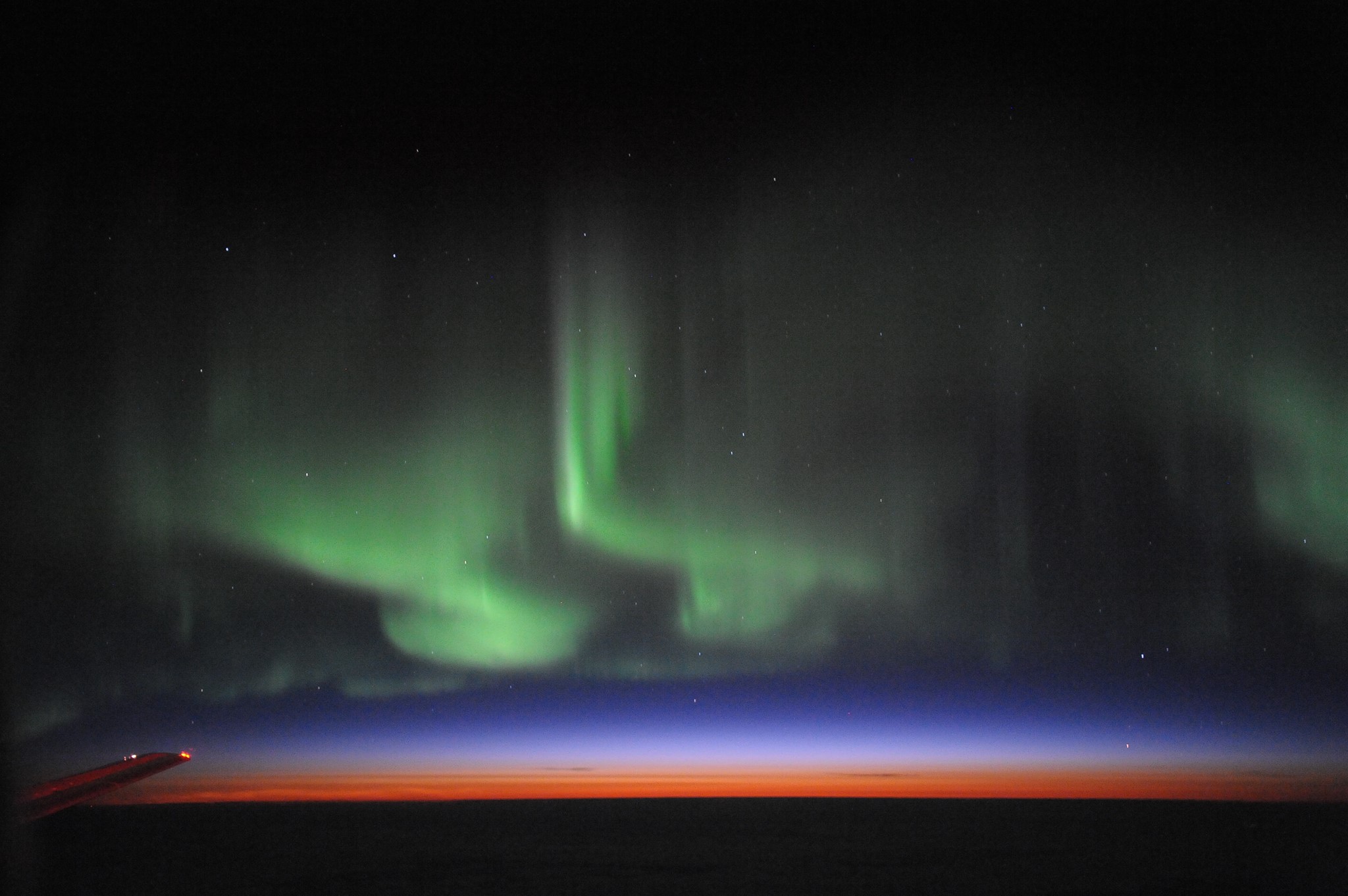
Aurora Borealis from 11.8 km over central Canada (Joseph A Shaw).
Here is a link where you can view 260 of my pictures from this trip.
It will be helpful if each participant registers before the 2013 light and color meeting. You can so online. The cost is $250 for a primary participant, including meeting registration, lunches on August 5. 6. and 7, and the evening expeditions (including the riverboat trip). The cost for an accompanying person is $50. For discounted student rates, please contact Dr. Ken Sassen (ksassen@gi.alaska.edu).
The full agenda has been posted for the 2013 light and color conference. It is still evolving, so please be patient.
(updated 26 Aug 2013 – final agenda)
Light and Color in Nature, 5–8 August 2013 at the University of Alaska Fairbanks
Monday, 5 August
Session 1: Introduction, 0900-1030, Kenneth Sassen Chair
Welcome by Robert McCoy, Director of the Geophysical Institute
Opening Remarks by Kenneth Sassen, Committee Chair
0930 Invited: Atmospheric optics at the early Geophysical Institute, Glenn Shaw
1000 Keynote: Noctilucent clouds – ice clouds at the edge of space in the polar summer, Richard Collins
Coffee break (continued registration), 1030-1100
Session 2: Historical Optics, 1100-1200, Joseph Shaw Chair
1100: 2.1 The 1665 orange halo of Huygens’s father, Gunther Konnen
1120: 2.2 The 35 minute green flash observed at Little America on 16 Oct 1929: a retrospective study, James Lock
1140: 2.3 The Nuremburg halo display of April 19, 1630, Eva Seidenfaden
Lunch (at the Geophysical Institute Globe Room), 1200-1300
1300 Invited: Cloud Forms, Stanley Gedzelman
Session 3: Scattering Interference Phenomena, 1330-1430, Stan Gedzelman Chair
1330: 3.1 Revisiting the corona, Philip Laven
1400: 3.2 The heiligenschein, John Adam and Philip Laven
Coffee Break, 1430-1500
Session 4: Ocean Color/Optics, 1500- 1640, Philip Laven Chair
1500: 4.1 Colors of thermal pools in Yellowstone National Park, Paul Nugent, Joseph Shaw and Michael Vollmer
1520: 4.2 Caustics due to complex water menisci, Charles Adler and James Lock
1540: 4.3 Improvement of remotely sensed Kd (PAR) of shallow turbid water in the Yellow Sea, Bumjun Kil and Stephan Howden
Public Optics Demonstration, 1730-1900, Kenneth Sassen Chair
Halomator and spectrodrom – a basement laboratory of atmospheric optics, by Michael Grossmann, Alexander Haussmann, and Elmar Schmidt
Conference Reception at the Museum of the North (light dinner), 1930-2100
Tuesday, 6 August
Registration, 0800-0900
Session 5: Ice Crystal Halos/Arcs, 0900-1030, Michael Vollmer Chair
0900: 5.1 Invited: “Lowitz Arcs Revisited”, Robert Greenler, Les Cowley, and Robert Gorkin
0930: 5.2 Halos due to scattering by randomly oriented crystals, Gunther Konnen
0950: 5.3 Brightness profile of the 22 degree halo, Dave Lynch
1010: 5.4 Pyramidal halo phenomenon in Virginia June 21st, 2010, Elmar Schmidt, T. Alan Clark, A. Haussmann, and Claudia Hinz
Coffee break, 1030-1100
Session 5 continued: Ice Crystal Halos/Arcs, 1100 -1200, Michael Vollmer Chair
1100: 5.5 Streetlight halos, Walter Tape
1120: 5.6 Parry’s arc from nearby light sources in Deadhorse, Alaska, Kenneth Sassen and Colin Triplett
1140: 5.7 Halo simulation progress report, Stanley Gedzelman
Lunch (at the Geophysical Institute Globe Room), 1200-1300
Session 5 continued: Ice Crystal Halos/Arcs, 1300-1350, Michael Vollmer Chair
1300: 5.8 Laboratory Demonstration, Position-related spectra within experimental parhelia: Simple hands-on experiments explaining the perceived color of sun dogs, K.-P. Mollmann and M. Vollmer
1330: 5.9 Brilliant colors from a white snow cover, Michael Vollmer and Joseph Shaw
Session 6: General Observations, 1350-1430, Gunther Konnen Chair
1350: 6.1 Unusual optical phenomena from mountain sites, Claudia Hinz
1410: 6.2 Establishment of the global meteopark system, Lai Bixing
Coffee Break, 1430-1500
Session 7 Biological Colors: 1530-1640, Robert Greenler Chair
1500: 7.1 On the purpose of color for living beings: a new theory of color organization, Katia Deiana and Baingio Pinna
1520: 7.2 How can a fish hide in the open ocean?, Robert Greenler
1540: 7.3 Iridescent colors in spider webs, H. Joachim Schlichting
1600: 7.4 Structural color of the butterfly wing scale, S. Yoshioka
1620: 7.5 Total internal reflection as solar protection for the Saharan desert ant Cataglyphis bombycina, Priscilla Simonis and Jean Pol Vigneron
Session 8 Mirages: 1640-1700, Robert Greenler Chair
1640: 8.1 Visible and invisible mirages: comparing inferior mirages in the visible and thermal infrared spectral range, Michael Vollmer, Joseph Shaw, Paul Nugent
Riverboat Discovery Chena River Excursion and Dinner, 1900-2200
Wednesday, 7 August
Session 9: Rainbows: 0900-1030, Walter Tape Chair
0900: 9.1 Invited: The natural tertiary rainbow- A photographic first, M. Grossmann
0930: 9.2 Photographic observation of a natural fifth-order rainbow, Harald Edens
0950: 9.3 Polarization and visibility of higher order rainbows, Gunther Konnen
1010: 9.4 Recent rainbow revelations, Robert Greenler
Coffee break, 1030-1100
Session 9 continued: Rainbows, 1100-1200, Walter Tape Chair
1100: 9.5 New insights into the rainbow, Part 1, Jean Louis Ricard, Peter Adams, and Jean Barckicke
1120: 9.6 New insights into the rainbow, Part 2, Jean Louis Ricard, Peter Adams, and Jean Barckicke
1140: 9.7 Observation, photogrammetry, and analysis of a twinned rainbow, Alexander Haussmann
Lunch (at the Geophysical Institute Globe Room), 1200-1300
Session 9 continued: Rainbows, 1300-1430, David Lynch Chair
1300: 9.8 A physically based rainbow simulator taking the background into consideration, Moon R. Jung
1320: 9.9 Influence of non-spherical raindrop shapes on higher order rainbows, Alexander Haussmann
1340: 9.10 Flashes of light below the dripping faucet: an optical signal from capillary oscillations of water drops, Thomas Timusk
1400: 9.11 Digital Imagery Forum, A post-Faustian review of digital imagery: the good, the bad, and the weird, Dave Lynch, Leader
Coffee Break, 1430-1500
Session 10: Atmospheric Color and Polarization, 1500-1720, Raymond Lee Chair
1500: 10.1 Seeing, adapting to, and reproducing the appearance of nature, Mark Fairchild
1520: 10.2 What is the spectrum of skylight polarization? Joseph Shaw and Nathan Pust
1540: 10.3 Measuring haze’s effects on the colors and visible-wavelength spectra of clear skies, Raymond Lee
1600: 10.4 Views affected by a wavy air-water surface, Yoav Y. Schechner
1620: 10.5 Simulating dark sunlit clouds, Stanley Gedzelman
1640: 10.6 Shadows, Dave Lynch
The Light & Color Official Slide Show (“pretty picture session”), 1715 to whenever
Thursday, 8 August
Session 11: Astronomical Optics, 0900-1030, Charles Adler Chair
0900: 11.1 Invited: Twilight’s Belt of Venus, by Raymond Lee
0930: 11.2 Visibility of Sirius in broad daylight, Gunther Konnen and Piet Stammes
0950: 11.3 Some elementary but surprising facts about the sun’s location in the sky, A. James Mallmann and Steven P. Mayer
1010: 11.4 Earthshine brightness and visibility, David Lynch
Coffee break, 1030-1100
Session 11 continued: Astronomical Optics, 1100-1200, Kenneth Sassen Chair
1100: 11.5 The use of light and color in astrophysical imaging, Travis A. Rector, Zoltan Levay, Lisa Frattare, Jayanne Engllish, and Kirk Pu-uohau-Pummill
1120: 11.6 Lunar eclipse photometry across the world – first correlations, Elmar Schmidt
1140: 11.7 Using light and color to detect life on Earth-like extra-solar planets, Eyal Schwartz, Stephen G. Lipson, and Erez N. Ribak
Concluding Remarks and Challenge, by Kenneth Sassen
Conference Concludes: 1215
Afternoon Tour of Chatanika gold mining area (lunch) and UAF Poker Flat Rocket Range
A preliminary agenda has been posted for the August 5-8, 2013 meeting in Fairbanks, Alaska. Authors should have received confirmation of their abstract acceptance via email. Questions about a specific abstract should be sent to Dr. Ken Sassen, conference chair (or as a backup, send questions to optics.submissions@gmail.com). General questions can be sent to Ken, to the gmail address, or posted here. See you all in Alaska soon!
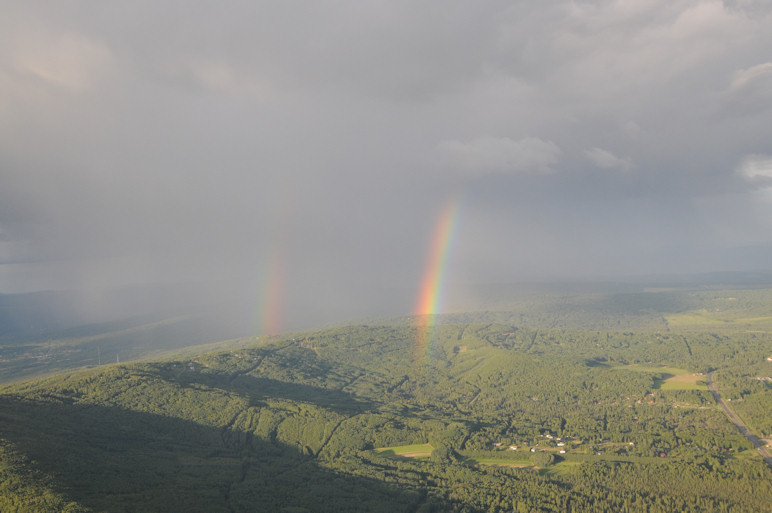
Double rainbow over the hills north of Fairbanks, Alaska (J. Shaw photo)
The city of Fairbanks was established in the early 20th century when gold was discovered nearby. Fairbanks sits at a low altitude (~136 m) in a broad river valley in central Alaska, between the Brooks Range of mountains to the north and the Alaska Range to the south. Fairbanks lies alongside the Chena and Tanana Rivers among rolling hills heavily forested with aspen, birch, pine, and spruce trees. Here is a list of some interesting things to see and places to go while visiting Fairbanks (in relatively random order).
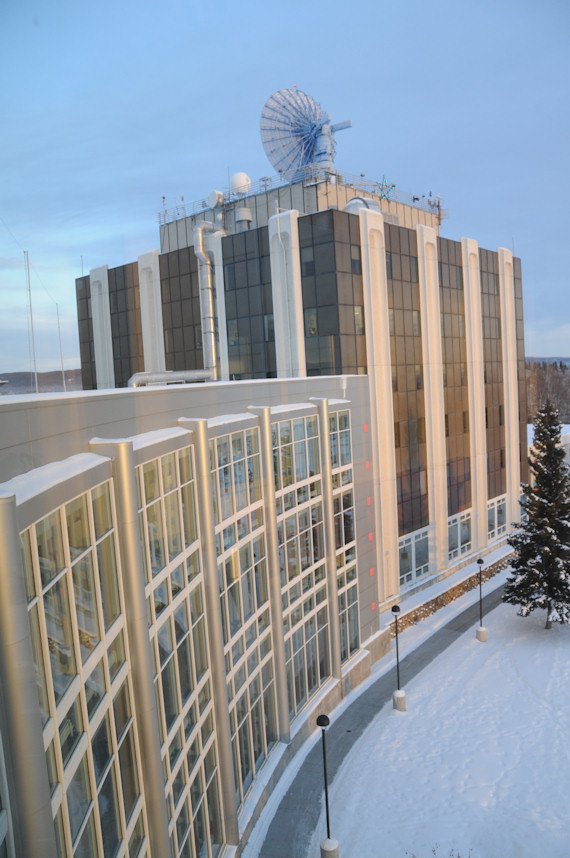
International Arctic Research Center and Geophysical Institute – site of the 2013 Light and Color in Nature Conference (J. Shaw photo).
University of Alaska – Fairbanks … the location of the light and color meeting … has much to offer, including the acclaimed Museum of the North, Native Art Center, Geophysical Institute (site of the meeting), and International Arctic Research Center.
Chena Hot Springs – A great weekend adventure located about 2 hours east of town on paved roads, this is a rustic hotel complex with bubbling hot springs. Chena Hot Springs Road is one of the best places for fishing and moose viewing. There is a shuttle van from Fairbanks to and from Chena Hot Springs.
Tanana Valley State Fair – this annual community event will occur August 2-11, 2013 – nicely overlapping the 2013 light and color meeting.
Creamer’s Field migratory waterfowl refuge is a beautiful place to take a morning or evening walk amidst local birds and nature.
Take a lunchtime or longer hike on the University of Alaska trails
Large Animal Research Station at the University of Alaska – Fairbanks, where you can see regional animals such as musk ox and caribou.
Take your picture by the 800-mile-long Trans-Alaska pipeline, an engineering marvel that pops up above ground in regions where a buried pipe could damage or be damaged by permafrost (permanently frozen earth). An ideal viewing point is located on the Steese Highway, just a few miles north of downtown Fairbanks.
Pioneer Park and the popular outdoor Salmon Bake, where you can learn about local history, dine on fresh Alaskan salmon or cod, and even rent a boat to enjoy the Chena River.
Local art galleries offer you the opportunity of viewing or even purchasing locally produced art.
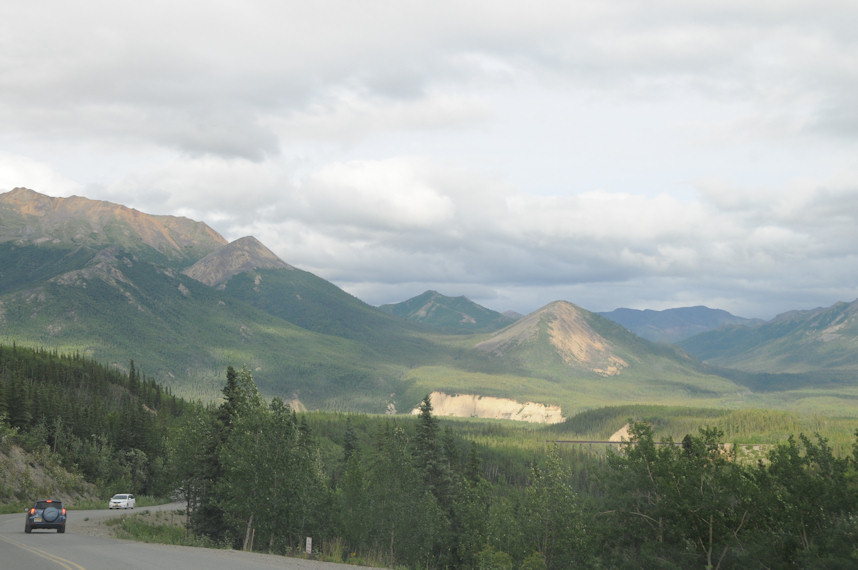
Denali National Park (J. Shaw photo)
– 2-3 hours south of Fairbanks and the home of Mt. McKinley (or Denali). Private cars can drive a modest distance into the park without a camping permit, after which you can travel by tour bus deeper into this beautiful wilderness
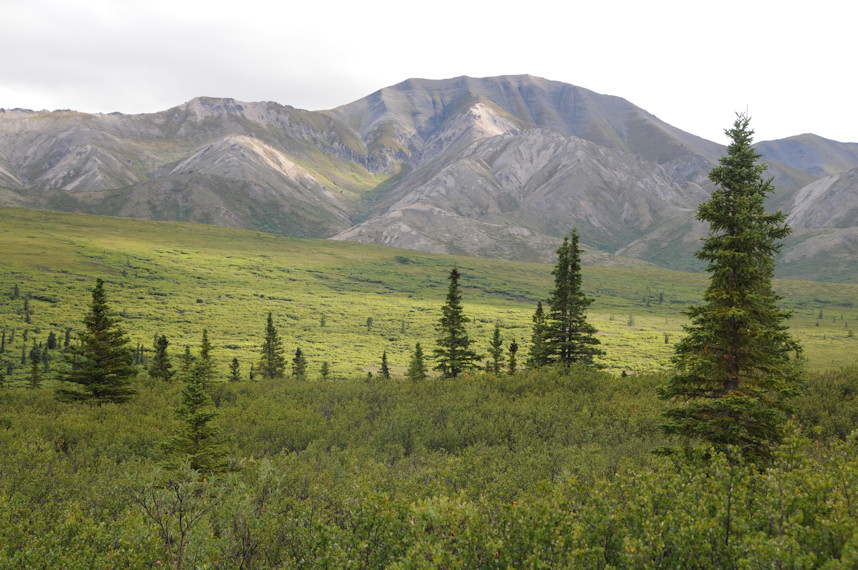
Denali National Park (J. Shaw photo)
area. This makes a beautiful day trip from Fairbanks or a wonderful multi-day expedition.
Denali Highway – a winding road through the Alaska Mountain Range, connecting Paxton with the Denali National Park. This road provides a true view of Alaska Wilderness, but beware of walking too far off the road without bear protection. Bears love it here, too!

Denali (or Mt. McKinley) in Denali National Park (J. Shaw photo)
Alaska Railroad – connects Fairbanks, Denali National Park, and the southern coastal city of Anchorage. One of the greatest adventure in interior Alaska is the slow, swaying Alaska Railroad trip from Fairbanks to Denali Village (“swaying” is a result of building railroad tracks on permafrost) in Denali National Park. You can also choose to continue on to Anchorage for the flight home (Anchorage is like a more normal city).
Dalton Highway– a rough gravel road that goes all the way up to the Deadhorse oil fields of the Beaufort Sea (where it will not get dark in August!). The real treat on this trip is the Brooks Mountain Range – wild country loaded with incredibly glaciated terrain, good fishing, and animal viewing. Lodging includes camping and one trucker’s hotel in Coldfoot. There are VERY few people who have made this trip. You will need a SUV for sure.
Valdez – southern terminus of the Trans-Alaska pipeline. Located ~6-8 hours drive south of Fairbanks on paved roads that take you through the heart of the Alaska Range, with small glaciers you can hike to at Thompson Pass. Valdez is a nice tourist town with frequent tour boats into the gorgeous Prince William Sound where you can see disappearing glaciers and wildlife that often includes whales.
Wrangell-St. Elias National park – situated several hours east of Anchorage or ~6 hours south of Fairbanks, this area offers large accessible glaciers and mining town ruins.
Native villages like Nome and Barrowon the Arctic Ocean are accessible only by air via small planes, but offer interesting opportunities to see a part of Alaska that is very different from the cities of Anchorage and Fairbanks.

Alaskan moose eating a garden snack (J. Shaw photo)
Click here for information about submitting abstracts to the 2013 meeting.